 rus
rus


Competent opinion
A. V. Vashchun
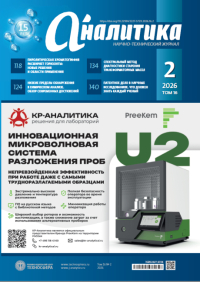
Microwave Sample Preparation is the Foundation of Modern Chemical Analysis Methods This paper describes a microwave sample digestion method, listing its main objectives, principles, applications, and advantages over other methods. The PreeKem U2 microwave sample preparation system is discussed, highlighting its performance with a wide range of samples. A diagram of the digestion process is presented, a specific example of mercury determination in food products is given, and the high degree of automation and operational safety are emphasized.
Microwave Sample Preparation is the Foundation of Modern Chemical Analysis Methods This paper describes a microwave sample digestion method, listing its main objectives, principles, applications, and advantages over other methods. The PreeKem U2 microwave sample preparation system is discussed, highlighting its performance with a wide range of samples. A diagram of the digestion process is presented, a specific example of mercury determination in food products is given, and the high degree of automation and operational safety are emphasized.
Tags: chemical analysis impurities microwave digestion of samples sample mineralization sample preparation микроволновое разложение проб минерализация проб примеси пробоподготовка химический анализ
Opinion
Modern laboratory
News
Analytics of Substances and Materials
V. K. Kozlov, D. M. Valiullina
Diagnostics of Aging of Transformer Oils Based on Their Transmission Spectra in the Visible Range This article examines the visible transmission spectra of transformer oils (TOs) as indicators of their aging. While aging is traditionally associated with oxidation, the authors identify an alternative mechanism – the accumulation of aromatic compounds that degrade the oils“ performance. Using spectroscopy, the authors established a relationship between transmission spectra, molecular absorption, and Rayleigh scattering by dispersed particles formed during aging. A direct correlation was found between aging and changes in transparency caused by increasing concentrations of dispersed particles and aromatic compounds. These data are important for operational quality control of oils and predicting their replacement intervals.
Diagnostics of Aging of Transformer Oils Based on Their Transmission Spectra in the Visible Range This article examines the visible transmission spectra of transformer oils (TOs) as indicators of their aging. While aging is traditionally associated with oxidation, the authors identify an alternative mechanism – the accumulation of aromatic compounds that degrade the oils“ performance. Using spectroscopy, the authors established a relationship between transmission spectra, molecular absorption, and Rayleigh scattering by dispersed particles formed during aging. A direct correlation was found between aging and changes in transparency caused by increasing concentrations of dispersed particles and aromatic compounds. These data are important for operational quality control of oils and predicting their replacement intervals.
Tags: aging monitoring aromatic compounds transformer diagnostics transformer oils transmission spectra visible spectrum ароматические соединения видимый диапазон диагностика трансформаторов мониторинг старения спектры пропускания трансформаторные масла
Chemical Analysis Metrology
B. L. Milman
Low Detection Limits in Chemical Analysis. A Review of Current Advances 10.22184/2227-572X.2026.16.2.124.132
A targeted search of scientific publications was conducted to establish the lowest limits of detection (LODs) achieved in modern chemical analysis. The lowest LODs were identified and classified into four groups of analytes of different nature. Each group is characterized by the 10 lowest limit values and their average values expressed in units of molar concentration of the solution (metals – 1.2 · 10−19 М, low organic molecules – 1.7 · 10−20 M, biopolymers – 1.3 · 10−22 M) or volume fraction in a gas mixture (7.2 · 10–16). The distribution of LODs for different analytes within these groups is considered, and the groups are compared. The data presented reflect the capabilities of modern analytical instruments, primarily new chemical sensors. These sensors have emerged due to the rapid development of nanotechnology and biotechnology (biosensors) and are driven by the need to detect very low concentrations for environmental protection, healthcare support, including early disease detection, food quality control, and various types of safety.
Low Detection Limits in Chemical Analysis. A Review of Current Advances 10.22184/2227-572X.2026.16.2.124.132
A targeted search of scientific publications was conducted to establish the lowest limits of detection (LODs) achieved in modern chemical analysis. The lowest LODs were identified and classified into four groups of analytes of different nature. Each group is characterized by the 10 lowest limit values and their average values expressed in units of molar concentration of the solution (metals – 1.2 · 10−19 М, low organic molecules – 1.7 · 10−20 M, biopolymers – 1.3 · 10−22 M) or volume fraction in a gas mixture (7.2 · 10–16). The distribution of LODs for different analytes within these groups is considered, and the groups are compared. The data presented reflect the capabilities of modern analytical instruments, primarily new chemical sensors. These sensors have emerged due to the rapid development of nanotechnology and biotechnology (biosensors) and are driven by the need to detect very low concentrations for environmental protection, healthcare support, including early disease detection, food quality control, and various types of safety.
Tags: biosensors data search detection limit progress of analytics record values sensors биосенсоры поиск информации предел обнаружения развитие аналитики рекордные показатели сенсоры
Analytical Methods and Instruments
O. M. Ivanova, A. N. Netesin, I. V. Smirnova
Comprehensive Certified Solutions for Wireless Microclimate Monitoring from JSC “ES&S” Modern requirements for microclimate control dictate the need for certified, high-tech solutions. Today monitoring environmental parameters is not just a technical task, but a crucial element of personnel safety, product integrity, and the stable operation of process equipment. This article provides a detailed examination of the key advantages, technical characteristics, and applications of continuous high-tech microclimate monitoring equipment based on certified IVTM 7 M 4-1 (Wi-Fi), IVTM 7 M 4(-D), IVTM 7 M 4(-D)-1 humidity and temperature meters, and IKV 8 air quality meters.
Comprehensive Certified Solutions for Wireless Microclimate Monitoring from JSC “ES&S” Modern requirements for microclimate control dictate the need for certified, high-tech solutions. Today monitoring environmental parameters is not just a technical task, but a crucial element of personnel safety, product integrity, and the stable operation of process equipment. This article provides a detailed examination of the key advantages, technical characteristics, and applications of continuous high-tech microclimate monitoring equipment based on certified IVTM 7 M 4-1 (Wi-Fi), IVTM 7 M 4(-D), IVTM 7 M 4(-D)-1 humidity and temperature meters, and IKV 8 air quality meters.
T. V. Volovik
35 Years in the Laboratory Equipment Market 10.22184/2227-572X.2026.16.2.104.105
35 Years in the Laboratory Equipment Market 10.22184/2227-572X.2026.16.2.104.105
T. I. Ivanova, A. V. Shepshelevich, I. V. Stepanov, D. A. Dmitriev, V. S. Yarmushov
Pelican – the First Russian Robotic Diffractometer for Residual Stress Analysis JSC Burevestnik Research Center is Russia“s largest research, development, and production company specializing in X-ray equipment for industrial and scientific purposes, and is a subsidiary of ALROSA (PJSC). Among its wide product line, X-ray diffractometers, whose serial production began 65 years ago and continues to this day, stand out in the company“s history. During this time, more than ten thousand diffractometers have been commissioned, successfully establishing themselves as reliable analytical tools for materials science research at all of the country“s renowned scientific and educational centers, federal universities, and institutes of the Russian Academy of Sciences, as well as at state corporations such as Rosatom, Roscosmos, and Rostec, the Russian Federal Nuclear Centers, the United Propulsion Corporation, and at companies such as Norilsk Nickel, Rosneft, RUSAL, and many others. This article presents a new development – the first Russian robotic diffractometer for residual stress analysis. The operating principle, characteristics, possible configurations, and applications of the device are described.
Pelican – the First Russian Robotic Diffractometer for Residual Stress Analysis JSC Burevestnik Research Center is Russia“s largest research, development, and production company specializing in X-ray equipment for industrial and scientific purposes, and is a subsidiary of ALROSA (PJSC). Among its wide product line, X-ray diffractometers, whose serial production began 65 years ago and continues to this day, stand out in the company“s history. During this time, more than ten thousand diffractometers have been commissioned, successfully establishing themselves as reliable analytical tools for materials science research at all of the country“s renowned scientific and educational centers, federal universities, and institutes of the Russian Academy of Sciences, as well as at state corporations such as Rosatom, Roscosmos, and Rostec, the Russian Federal Nuclear Centers, the United Propulsion Corporation, and at companies such as Norilsk Nickel, Rosneft, RUSAL, and many others. This article presents a new development – the first Russian robotic diffractometer for residual stress analysis. The operating principle, characteristics, possible configurations, and applications of the device are described.
Tags: residual stress robotic diffractometer x-ray diffraction остаточное напряжение рентгеновская дифракция роботизированный дифрактометр
Personnel Training
T. O. Kozlova, N. B. Guseva, M. O. Ignatiev
Patenting in Scientific Research This article examines the specifics of patenting in scientific research. Key concepts in patent law ‒ such as results of intellectual activity, intellectual property, invention, utility model, and patentability conditions ‒ are discussed, including in the context of the chemical industry. Fundamental approaches to filing a patent application are described. The process of preparing for patenting in biomedical research is examined in detail, using the example of developing treatments for nocturnal enuresis in children and adolescents at the Children“s City Clinical Hospital No. 9 named after G. N. Speransky. Particular attention is paid to the statistical processing of the results of a scientific experiment conducted for patenting purposes with a small sample size.
Patenting in Scientific Research This article examines the specifics of patenting in scientific research. Key concepts in patent law ‒ such as results of intellectual activity, intellectual property, invention, utility model, and patentability conditions ‒ are discussed, including in the context of the chemical industry. Fundamental approaches to filing a patent application are described. The process of preparing for patenting in biomedical research is examined in detail, using the example of developing treatments for nocturnal enuresis in children and adolescents at the Children“s City Clinical Hospital No. 9 named after G. N. Speransky. Particular attention is paid to the statistical processing of the results of a scientific experiment conducted for patenting purposes with a small sample size.
Tags: methods of treatment patent law patent search statistical processing патентное право патентный поиск способы лечения статистическая обработка
Historic chapters