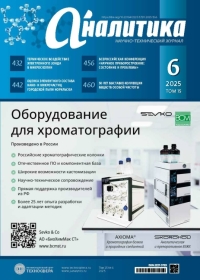
 rus
rus


Exhibitions and Conferences
V. V. Rodchenkova
All-Russian Conference Russian Scientific Instrument Engineering: Status and Challenges 10.22184/2227-572X.2025.15.6.456.459
From October 14 to 16, 2025, the representative and large-scale Scientific and Practical Conference “Russian Scientific Instrument Engineering: Status and Challenges” was held in Chernogolovka. Over 200 participants – scientists, engineers, representatives of universities and research centers, academic and industry institutes – gathered to exchange experiences, establish contacts between scientific and industrial teams, and discuss not only past achievements and current issues, but also the real challenges facing the industry and its development prospects.
All-Russian Conference Russian Scientific Instrument Engineering: Status and Challenges 10.22184/2227-572X.2025.15.6.456.459
From October 14 to 16, 2025, the representative and large-scale Scientific and Practical Conference “Russian Scientific Instrument Engineering: Status and Challenges” was held in Chernogolovka. Over 200 participants – scientists, engineers, representatives of universities and research centers, academic and industry institutes – gathered to exchange experiences, establish contacts between scientific and industrial teams, and discuss not only past achievements and current issues, but also the real challenges facing the industry and its development prospects.
Tags: all-russian conference equipment russian academy of sciences scientific instrument engineering всероссийская конференция научное приборостроение оборудование российская академия наук
News
Analytics of Substances and Materials
M. N. Filippov, M. A. Stepovich
Thermal Effect of an Electron Probe on a Sample in Scanning Electron Microscopy and Electron Probe Microanalysis 10.22184/2227-572X.2025.15.6.432.441
This article provides a critical review of the current state of research on assessing the thermal impact of an electron probe in scanning electron microscopy and electron probe microanalysis. The focus is on theoretical estimates of the superheat temperature of a sample. Two main areas of research are considered. The first area includes studies based on a rigorous solution to the boundary value problem for the differential equation of heat conduction with a right-hand side that most accurately describes the electron deceleration process in a substance. This area also includes studies using the Monte Carlo method. The second area involves the use of simplified heat generation models, allowing one to obtain analytical expressions for the superheat temperature. Results obtained by various methods are compared.
Thermal Effect of an Electron Probe on a Sample in Scanning Electron Microscopy and Electron Probe Microanalysis 10.22184/2227-572X.2025.15.6.432.441
This article provides a critical review of the current state of research on assessing the thermal impact of an electron probe in scanning electron microscopy and electron probe microanalysis. The focus is on theoretical estimates of the superheat temperature of a sample. Two main areas of research are considered. The first area includes studies based on a rigorous solution to the boundary value problem for the differential equation of heat conduction with a right-hand side that most accurately describes the electron deceleration process in a substance. This area also includes studies using the Monte Carlo method. The second area involves the use of simplified heat generation models, allowing one to obtain analytical expressions for the superheat temperature. Results obtained by various methods are compared.
Tags: electron microscope electron probe microanalysis heat generation by an electron probe mathematical modeling of heat flow генерация тепла электронным зондом математическое моделирование переноса тепла электронно-зондовый микроанализ электронный микроскоп
A. S. Brzhezinskiy, A. I. Ivaneev, M. S. Ermolin, V. K. Karandashev, N. A. Krivolutskaya, P. S. Fedotov
Evaluation of the Elemental Composition and Pollution Degree of Nano- and Microparticles in Urban Dust of Norilsk City Using Field-Flow Fractionation 10.22184/2227-572X.2025.15.6.442.454
Nanoparticles of urban dust are characterized by extremely high mobility in the environments and can easily penetrate living organisms. The investigation of elemental composition of nanoparticles of urban dust is challenge due to the difficulty of their separation for following quantitative analysis. In the current study, the elemental composition and pollution degree of nano- and microparticles in urban dust of Norilsk city were evaluated using an integrated approach based on the method of field-flow fractionation in a rotating coiled column developed at the Vernadsky Institute of Geochemistry and Analytical Chemistry, Russian Academy of Sciences. The nano- and microparticles under study were found to be contaminated by Cr, Co, Ni, Cu, Pb, and Zn. It was shown that the total degree of contamination and potential ecological risk are higher for microparticles as compared to nanoparticles of urban dust. It can be assumed that these elements in the emissions of Norilsk’s industrial enterprises are primarily in the form of microparticles, which, in turn, represent the main sources of their accumulation in urban dust.
Evaluation of the Elemental Composition and Pollution Degree of Nano- and Microparticles in Urban Dust of Norilsk City Using Field-Flow Fractionation 10.22184/2227-572X.2025.15.6.442.454
Nanoparticles of urban dust are characterized by extremely high mobility in the environments and can easily penetrate living organisms. The investigation of elemental composition of nanoparticles of urban dust is challenge due to the difficulty of their separation for following quantitative analysis. In the current study, the elemental composition and pollution degree of nano- and microparticles in urban dust of Norilsk city were evaluated using an integrated approach based on the method of field-flow fractionation in a rotating coiled column developed at the Vernadsky Institute of Geochemistry and Analytical Chemistry, Russian Academy of Sciences. The nano- and microparticles under study were found to be contaminated by Cr, Co, Ni, Cu, Pb, and Zn. It was shown that the total degree of contamination and potential ecological risk are higher for microparticles as compared to nanoparticles of urban dust. It can be assumed that these elements in the emissions of Norilsk’s industrial enterprises are primarily in the form of microparticles, which, in turn, represent the main sources of their accumulation in urban dust.
Tags: field-flow fractionation microparticles nanoparticles pollution urban dust городская пыль загрязнение микрочастицы наночастицы фракционирование в поперечном поле
Analytical Methods and Instruments
S. M. Staroverov
Axioma – Domestic Chromatography Equipment for Protein Separation 10.22184/2227-572X.2025.15.6.410.415
The article is devoted to the domestic line of chromatographs for protein separation Axioma. Examples of application of industrial chromatographs and characteristics of new laboratory chromatographs Axioma Debut and Axioma Standard with the use of domestic critical components are presented. The equipment provides operation in gradient mode using ultraviolet and conductometric detectors. The control is carried out by the domestic software complex MultiChrom Axioma that allows to expand the functional characteristics of the equipment. The chromatograph Axioma Standard provides operation with pressure up to 100 bar, which makes it possible to use highly efficient columns for proteins separation with small particles and to implement all the main methods of protein separation.
Axioma – Domestic Chromatography Equipment for Protein Separation 10.22184/2227-572X.2025.15.6.410.415
The article is devoted to the domestic line of chromatographs for protein separation Axioma. Examples of application of industrial chromatographs and characteristics of new laboratory chromatographs Axioma Debut and Axioma Standard with the use of domestic critical components are presented. The equipment provides operation in gradient mode using ultraviolet and conductometric detectors. The control is carried out by the domestic software complex MultiChrom Axioma that allows to expand the functional characteristics of the equipment. The chromatograph Axioma Standard provides operation with pressure up to 100 bar, which makes it possible to use highly efficient columns for proteins separation with small particles and to implement all the main methods of protein separation.
Tags: columns medium and low pressure chromatographs axioma protein separation chromatography software колонки для хроматографии белков программное обеспечение хроматография белков хроматографы среднего и низкого давления «аксиома»
BWT Water Treatment – A Modern Alternative to Distillers
10.22184/2227-572X.2025.15.6.416.418
L. G. Shaidarova, I. A. Chelnokova, D. A. Koryakovtseva, H. C. Budnikov, M. A. Ziganshin
Sequential Injection Amperometric Determination of Xanthine on an Electrode Modified with a Composite Based on Iridium and Bismuth 10.22184/2227-572X.2025.15.6.420.427
It was shown that the catalytic activity of metal modifiers manifests itself during the electrooxidation of xanthine on planar electrodes with electrodeposited iridium and bismuth particles. For the sequential injection amperometric determination of this compound, hydraulic circuits with a flow-through electrochemical cell of the reflective wall type or a microfluidic cell with planar electrodes modified with a composite based on iridium and bismuth were used. A linear logarithmic dependence of the analytical signal on the xanthine concentration was observed in the ranges from 5 · 10−7 to 5 · 10−3 M when using a cell of the reflective wall type, from 5 · 10−9 М to 5 · 10−3 М when using a microfluidic cell.
Sequential Injection Amperometric Determination of Xanthine on an Electrode Modified with a Composite Based on Iridium and Bismuth 10.22184/2227-572X.2025.15.6.420.427
It was shown that the catalytic activity of metal modifiers manifests itself during the electrooxidation of xanthine on planar electrodes with electrodeposited iridium and bismuth particles. For the sequential injection amperometric determination of this compound, hydraulic circuits with a flow-through electrochemical cell of the reflective wall type or a microfluidic cell with planar electrodes modified with a composite based on iridium and bismuth were used. A linear logarithmic dependence of the analytical signal on the xanthine concentration was observed in the ranges from 5 · 10−7 to 5 · 10−3 M when using a cell of the reflective wall type, from 5 · 10−9 М to 5 · 10−3 М when using a microfluidic cell.
Tags: chemically modified electrodes electrooxidation of xanthine flow-injection analysis iridium and bismuth microfluidic cell screen-printed electrode иридий и висмут микрофлюидная ячейка планарный электрод последовательный инжекционный анализ химически модифицированные электроды электроокисление ксантина
Historic chapters
M. F. Churbanov, E. N. Volkova, O. P. Lazukina, K. K. Malyshev
50th Anniversary of the Exhibition-Collection of High-Purity Substances 10.22184/2227-572X.2025.15.6.460.467
This article provides a brief historical overview of the activities of the Exhibition-Collection of High-Purity Substances, established in 1974. It recognizes the outstanding scientists who founded the Exhibition-Collection and played a significant role in organizing its work. The organizations that actively contributed to the expansion of the collection of high-purity substances are listed. The main activities of the Exhibition-Collection are discussed, with the goals of studying the impurity composition as a fundamental characteristic of high-purity substances and monitoring the achieved level of purity in Russia and worldwide. The Exhibition-Collection presents 761 samples of high-purity substances obtained from 149 research and industrial enterprises in Russia and the CIS. The important role of the Information and Calculation System High-Purity Substances and Materials is emphasized. It was created to store and process a large, ever-growing array of data containing information about the impurity composition of high-purity substances, their properties, production methods, metrological characteristics of the most sensitive analytical methods, as well as information on high-purity substance manufacturers, their product characteristics, regulatory and technical documentation, etc. The current purity level of simple substances produced in Russia and worldwide is compared with the purity level of the best exhibition samples.
50th Anniversary of the Exhibition-Collection of High-Purity Substances 10.22184/2227-572X.2025.15.6.460.467
This article provides a brief historical overview of the activities of the Exhibition-Collection of High-Purity Substances, established in 1974. It recognizes the outstanding scientists who founded the Exhibition-Collection and played a significant role in organizing its work. The organizations that actively contributed to the expansion of the collection of high-purity substances are listed. The main activities of the Exhibition-Collection are discussed, with the goals of studying the impurity composition as a fundamental characteristic of high-purity substances and monitoring the achieved level of purity in Russia and worldwide. The Exhibition-Collection presents 761 samples of high-purity substances obtained from 149 research and industrial enterprises in Russia and the CIS. The important role of the Information and Calculation System High-Purity Substances and Materials is emphasized. It was created to store and process a large, ever-growing array of data containing information about the impurity composition of high-purity substances, their properties, production methods, metrological characteristics of the most sensitive analytical methods, as well as information on high-purity substance manufacturers, their product characteristics, regulatory and technical documentation, etc. The current purity level of simple substances produced in Russia and worldwide is compared with the purity level of the best exhibition samples.
Tags: exhibition-collection of high-purity substances high-purity substances impurity composition purity level monitoring высокочистые вещества выставка-коллекция веществ особой чистоты мониторинг уровня чистоты примесный состав
A. S. Paevskii
Exhibits from the Virtual Chemistry Museum Collection. New Popular Library of Chemical Elements. Helium 10.22184/2227-572X.2025.15.6.468.474
Exhibits from the Virtual Chemistry Museum Collection. New Popular Library of Chemical Elements. Helium 10.22184/2227-572X.2025.15.6.468.474
Annual Issue